
How Melbourne Businesses Can Reduce Fitout Costs With Existing Infrastructure
Author
Shawn Vandersay
Date Published
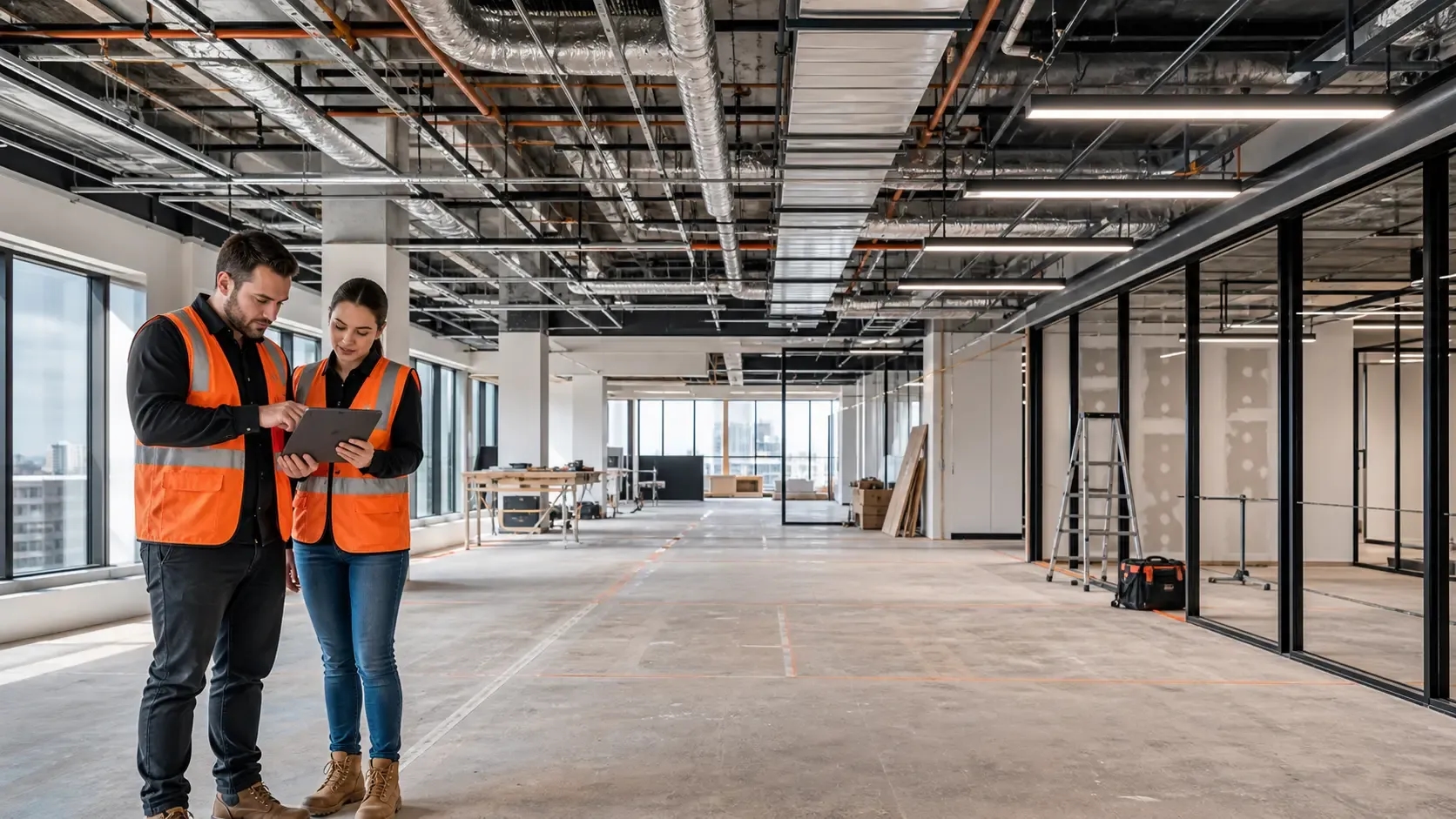
Many Melbourne business owners ask this before starting a fitout. The short answer is yes. Existing infrastructure can reduce costs when it suits the new layout and passes proper checks.
But reuse is not always cheaper. Old services, damaged finishes, and poor planning can turn a saving into a costly delay.
The safest rule is simple: audit first, design second, demolish last.
Existing infrastructure can reduce demolition, waste removal, material purchases, trade labour, and procurement delays. In suitable projects, reuse may help reduce fitout costs by 10 to 30 percent. The result depends on the site, condition, compliance needs, and business use.
Fast Facts
- Cost control: Reusing existing services can reduce demolition, labour, and material costs.
- Site checks: Electrical, HVAC, plumbing, fire services, and asbestos risks should be reviewed early.
- Timeline impact: Reuse can speed up work when services are ready, but hidden issues can delay the project.
- Decision rule: Keep infrastructure when it is safe, compliant, well placed, and reliable.
Why This Matters For Melbourne Businesses
Commercial fitout costs in Melbourne vary widely. A simple office refresh costs less than a clinic, restaurant, or full retail fitout. Warehouses can be more cost-effective, but mezzanine floors and heavy services can still increase the budget.
As a rough guide, Melbourne office fitouts can range from basic open-plan work at the lower end to more complex fitouts above $3,000 per square metre. Retail, clinic, and hospitality spaces often cost more because they need extra services, finishes, and compliance checks.
Many Melbourne businesses also operate in older buildings. Pre-1990s properties may have asbestos, old wiring, poor HVAC, access issues, or previous non-compliant work. These hidden issues can affect both cost and timing.
This is why reuse should never be a guess. It should be a planned decision.
What Existing Infrastructure Can Often Be Reused?
Some fitout elements are easier to reuse than others. The best candidates are stable, compliant, and in good condition.
Common reusable elements include:
🔸 Suspended ceilings and ceiling grids
🔸 Light fittings and flooring
🔸 Internal partitions and glazed walls
🔸 Joinery, counters, and storage
🔸 Power, data, plumbing, and HVAC points
🔸 Fire services, mezzanines, kitchens, and amenities
The key question is not whether something exists. The real question is whether it supports the new business use.
A retail store, office, clinic, showroom, and warehouse all need different layouts. A system that worked for the last tenant may not suit your staff, customers, equipment, or compliance needs.
When Reuse Can Save Money
Reuse works best when the current space already supports the new plan. This often happens in light office refurbishments, showroom upgrades, and warehouse improvements.
For example, a Melbourne office may keep its ceiling grid, carpet tiles, and meeting room partitions. If the new desk layout follows existing power and data points, the business may avoid major electrical relocation costs.
Reuse can also reduce downtime. If floors, ceilings, and services stay in place, the project may need less demolition and fewer trade hours. That can help businesses open sooner or keep operating during staged works.
There is also a sustainability benefit. Keeping useful materials out of landfill can reduce waste and lower embodied carbon. This can matter to landlords, tenants, and businesses with environmental goals.
Related Insight
If you are planning a healthcare space, review our guide on medical clinic fit out cost per square meter in Melbourne to better understand project budgeting and planning.
When Reuse Can Cost More Than Replacement
Reuse becomes risky when old infrastructure hides problems. It can also cost more when repair work takes longer than replacement.
For example, old wiring may need a full upgrade. An existing HVAC system may not suit a new room layout. Flooring may look fine until walls move and patch marks appear. Ceiling tiles may be hard to match after services change.
Older buildings can also contain asbestos in ceilings, flooring, insulation, or ducts. If fitout work disturbs asbestos, the project needs proper management and licensed removal where required.
In these cases, replacement may give a cleaner result, clearer pricing, and lower long-term risk.
A useful rule is this: keep it if it is safe, compliant, well placed, and reliable. Replace it if it creates risk, delay, or poor performance.
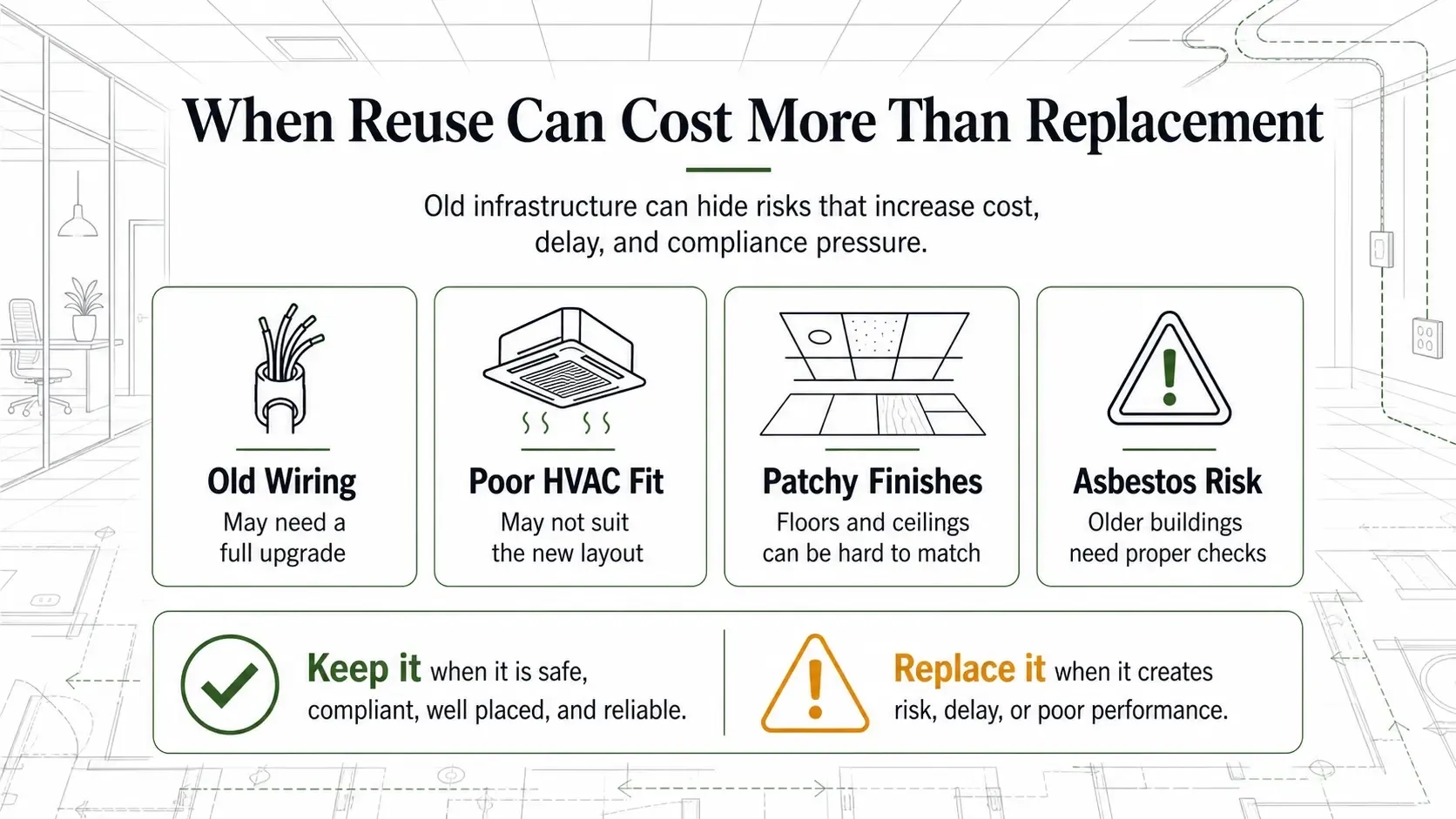
Reusing existing infrastructure can reduce fitout costs, but old wiring, poor HVAC fit, patchy finishes, and asbestos risks may make replacement safer and more cost-effective.
Why A Site Audit Should Come First
A site audit helps you decide what can stay before drawings and quotes are locked in. It gives the builder, designer, and trades better information.
A proper audit should review electrical supply, plumbing, HVAC, fire services, ceilings, flooring, partitions, accessibility, asbestos risk, and building compliance. It should also map service locations, including power, data, drainage, vents, and switchboards.
This audit should happen early. Ideally, it should happen before final layout approval.
Late checks often lead to redesigns, quote changes, and delays. Early checks help the team price the project more accurately and avoid surprise variations.
Electrical And Data Layouts Can Affect The Budget
Electrical and data points have a major impact on fitout cost. They affect desks, counters, registers, meeting rooms, treatment rooms, warehouse offices, and equipment zones.
You can often save money by designing around existing power and data points. This works well when the current supply is safe, tested, and suitable for the new use.
Moving outlets may look simple on a plan. On site, it can involve ceiling access, wall chasing, new cabling, testing, and certification.
In Victoria, electrical installation work must be completed by licensed electricians. A Certificate of Electrical Safety may also be required for the completed work.
HVAC Reuse Needs Careful Review
Air conditioning is one area where reuse needs extra care. Existing HVAC may save money, but only if it suits the new layout and occupancy.
A larger team, new walls, extra treatment rooms, or different trading hours can change heating, cooling, and ventilation needs. Poor zoning can create hot spots, cold areas, noise issues, and higher energy bills.
This is especially important for clinics, offices, hospitality spaces, and converted warehouses. These spaces may need better fresh air, indoor air quality, and service access than the previous tenant required.
Before keeping HVAC, ask for a professional review of capacity, zoning, maintenance history, filters, ducts, vents, and compliance needs.
Plumbing And Wet Areas Can Hide Expensive Issues
Plumbing reuse can save money when wet areas already sit in the right place. This can help offices, clinics, salons, cafes, and staff amenity upgrades.
But plumbing problems often stay hidden until walls, floors, or ceilings open. Low water pressure, poor drainage, leaks, and missing certificates can all affect the project.
Designing around existing plumbing can reduce cost. But forcing a poor layout around old plumbing can hurt daily operations.
In Victoria, some plumbing work needs a compliance certificate. Plumbing work valued at $750 or more often triggers certification requirements, so this should be checked before work begins.
Compliance Can Change The Reuse Decision
Compliance is one of the main reasons reuse needs expert checks. A building element may look usable but still fail current requirements.
Melbourne commercial fitouts may involve the National Construction Code, Victorian building permit rules, fire safety, accessibility, electrical safety, plumbing compliance, asbestos management, and energy efficiency requirements.
Building classification also matters. Offices are generally Class 5. Shops and cafes are usually Class 6. Warehouses are often Class 7. Some medical uses may trigger Class 9a requirements.
If the business use changes, compliance needs may also change. This can affect what can be reused and what must be upgraded.
How Reuse Can Affect Timelines And Downtime
Reuse can shorten a project when existing services are ready to use. It can also delay a project when hidden issues appear after work starts.
A Melbourne commercial fitout may take 4 to 8 weeks for construction. The full project may take longer once design, permits, approvals, procurement, and handover are included.
Common delays include late service checks, asbestos discovery, electrical upgrades, HVAC redesign, plumbing repairs, fire service changes, and building manager approvals.
To reduce downtime, plan works in stages. Keep key business areas open where possible. Schedule noisy work after hours. Confirm service shutdowns early. Also build a contingency into the timeline and budget.
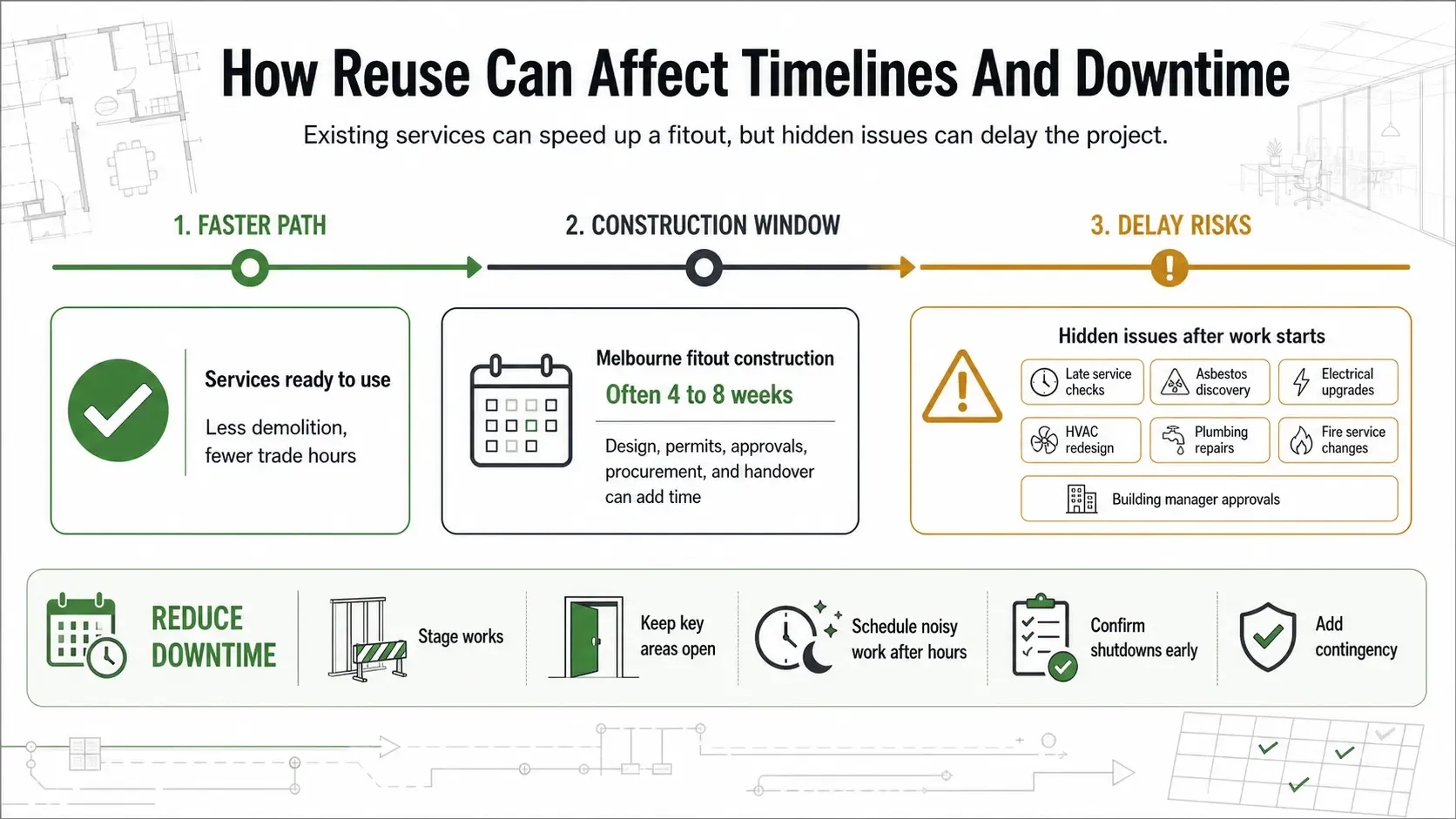
Reusing existing services can help shorten a fitout, but late checks, asbestos, service upgrades, and approvals can still delay work. Staging, after-hours scheduling, early shutdown planning, and contingency help reduce downtime.
Keep, Repair, Relocate, Or Replace?
Use a simple decision framework before approving the fitout budget. Keep infrastructure when it is safe, compliant, reliable, and already supports the new layout.
Repair it when damage is minor, matching is practical, and the repair cost is clear. Relocate services when the move improves the layout and costs less than full replacement.
Replace infrastructure when it is unsafe, non-compliant, outdated, poorly located, or likely to cause future downtime.
Before making the final call, ask contractors for evidence. Request a cost comparison between repair and replacement. Also ask how each option affects timing, compliance, and business disruption.
Need Help Reviewing Existing Fitout Infrastructure?
Reducing fitout costs is not about keeping everything. It is about knowing what is worth keeping before work starts.
Finex Fitouts helps Melbourne businesses assess existing infrastructure, plan practical layouts, and manage fitout works from design to delivery. A clear site review can help reduce waste, avoid delays, and support better budget decisions.
FAQs
Can reusing existing infrastructure really reduce fitout costs?
Yes. Reusing suitable ceilings, flooring, partitions, power, data, plumbing, or HVAC can reduce demolition, labour, and material costs. It only saves money when the existing infrastructure is safe, compliant, and suitable for the new layout.
What should Melbourne businesses check before reusing fitout infrastructure?
A site audit should check electrical capacity, plumbing, HVAC, fire services, accessibility, asbestos risk, building compliance, and the condition of flooring, ceilings, and partitions. These checks help reduce hidden costs and project delays.
When is replacement better than reuse in a commercial fitout?
Replacement is often better when infrastructure is unsafe, non-compliant, outdated, poorly located, or likely to cause future downtime. Old wiring, unsuitable HVAC, damaged finishes, asbestos risk, or failed compliance checks can make replacement the smarter option.
Confused about office renovation vs fitout? Learn costs, timelines, and how to choose the right option for your business.
Learn turnkey fitout costs in Australia 2026. Melbourne pricing, timelines, hidden costs, and how to avoid budget blowouts.