
Best Materials for Shopfitting Fixtures: A Practical Guide to Durability, Style, and Cost
Author
Shawn Vandersay
Date Published
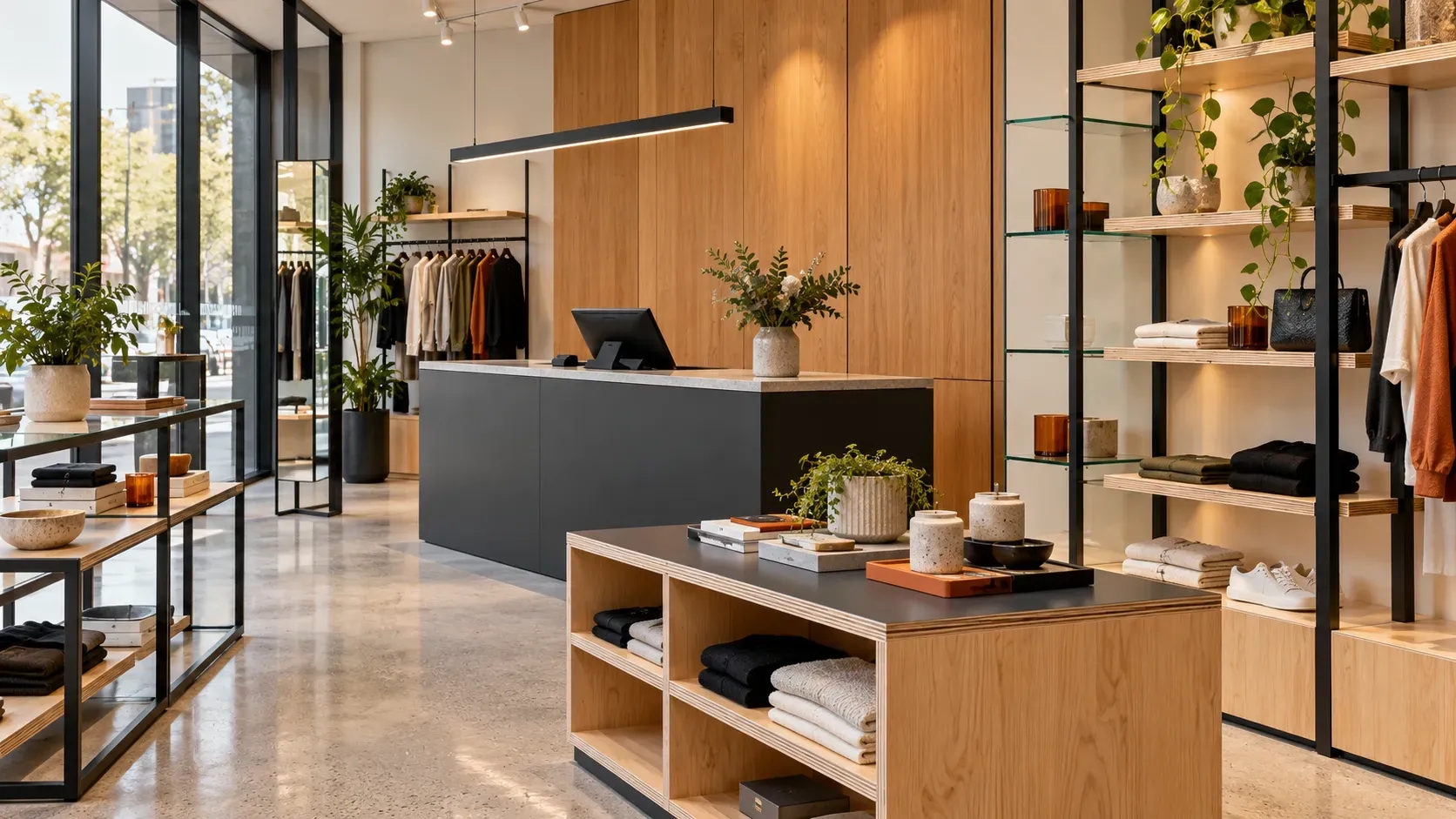
A low-cost fixture can become expensive when its edges chip or its panels swell. However, the highest-priced material is not always the right choice.
Good shopfitting fixture materials must suit the fixture’s location and daily use. They must also support your brand, budget, cleaning routine, and project schedule.
Fast Facts
- Strong all-round choice: High-pressure laminate suits busy counters and customer-facing fixtures.
- Cost-conscious choice: Melamine board works well for dry storage, cabinet interiors, and lower-impact areas.
- Structural choice: Plywood and metal provide strength for shelves, frames, rails, and demanding fixing points.
- Wet-area choice: Compact laminate and suitable solid surfaces support frequent cleaning and moisture exposure.
- Planning rule: Compare lifecycle cost, compliance, maintenance, and lead time before approving a material.
What Is the Best Material for Shopfitting Fixtures?
There is no single material that works for every shopfitting fixture. Most successful retail fixtures combine several materials.
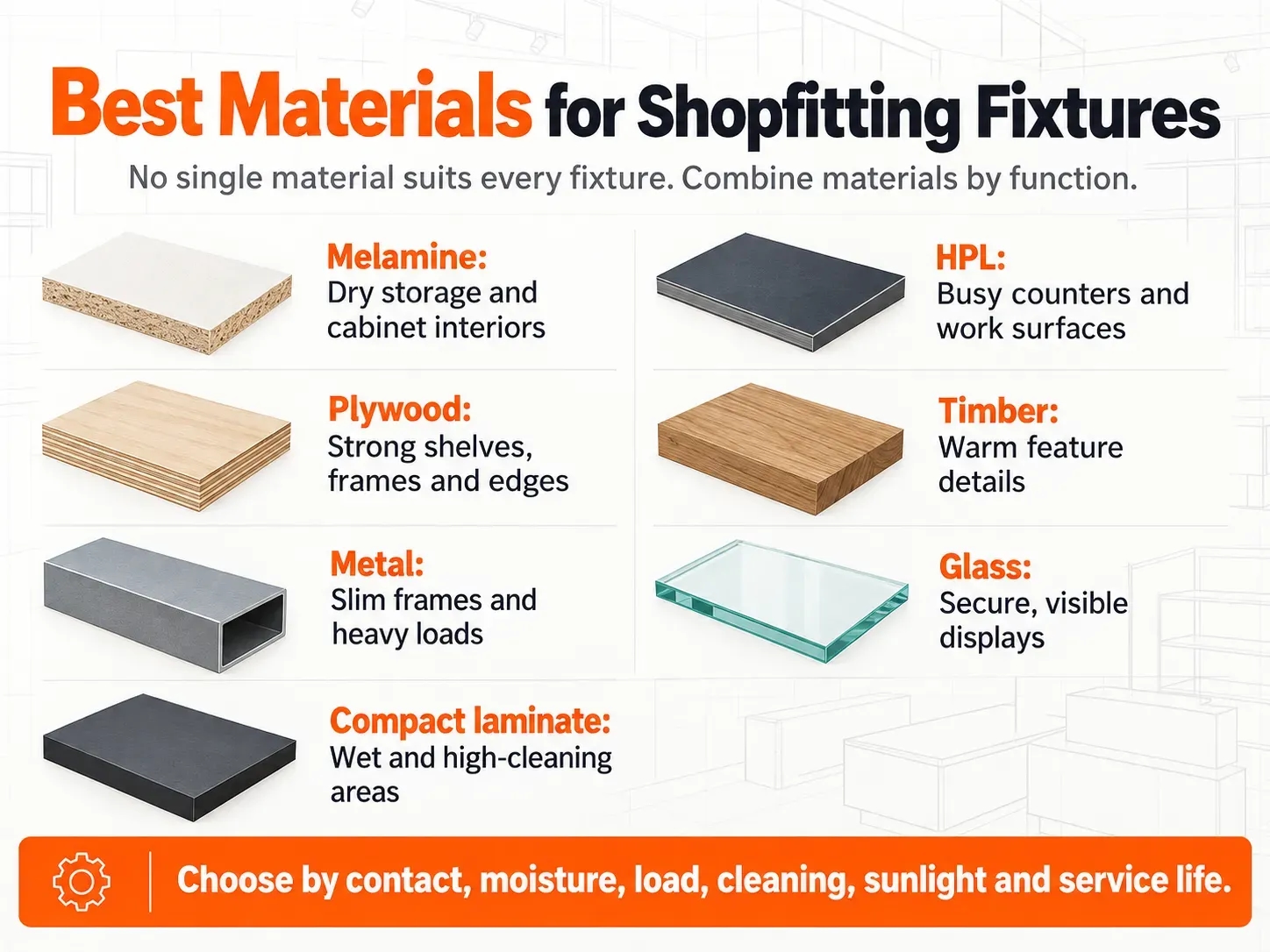
A practical comparison of materials for retail counters, shelving, storage, frames, displays, and wet areas.
Start with the fixture’s function before choosing its finish. Consider customer contact, moisture, weight, cleaning, sunlight, and expected service life.
How the Main Shopfitting Materials Compare
MDF, Particleboard, and Laminates
Melamine-faced particleboard is often the lowest-cost option for commercial joinery. It offers consistent colours and wood-look finishes without painting.
It works well for cabinet interiors, storage units, and low-impact shelving. However, damaged edges can admit moisture and lead to swelling.
MDF has a smooth and consistent surface. It suits painted counters, routed panels, curved details, and branded feature shapes.
Standard MDF belongs in dry indoor areas. Moisture-resistant MDF provides more protection, but it is not waterproof.
High-pressure laminate is a strong surface choice for busy counters and display furniture. It resists common wear, impact, heat, and stains when correctly specified.
The substrate still matters. Sealed joints, strong edging, and careful fabrication help prevent damage around corners and sinks.
Plywood, Veneer, and Solid Timber
Plywood combines strength with a distinctive layered edge. It holds many mechanical fixings well and can support demanding shelf or cabinet designs.
Appearance-grade plywood may remain visible as part of the design. It can also receive laminate, paint, or clear protective finishes.
Timber veneer creates a natural finish without the weight and cost of solid timber. It works well on counter fronts, wall panels, and feature displays.
Veneer still needs a suitable coating. Designers should also allow for natural variation between sheets and batches.
Solid timber suits trims, handles, feature shelves, and high-contact details. It can often be sanded or refinished after damage.
However, timber can move as humidity changes. Proper detailing and acclimatisation help reduce gaps, movement, and distortion.
Metal, Glass, Compact Laminate, and Solid Surface
Powder-coated steel provides strong frames, brackets, hanging rails, and display structures. Aluminium offers a lighter option with good corrosion resistance.
Metal can create thinner profiles than timber-based boards. Fabrication, welding, coatings, and transport can increase the initial cost.
Glass keeps displays visually open and allows customers to see products clearly. Its type, thickness, support, and exposed edges need professional specification.
Compact laminate performs well in wet and heavily cleaned areas. It suits change-room benches, partitions, counters, and selected food-service applications.
Acrylic solid surface can create smooth counters with discreet joints. Many products can also be repaired after minor surface damage.
Match the Material to the Fixture and Location
Checkout counters face bags, keys, equipment, and repeated cleaning. High-pressure laminate or solid surface usually performs better than a delicate painted finish.
Product shelving must support its expected load without sagging. Shelf width, thickness, brackets, fixings, and substrate all affect performance.
Food displays require surfaces that support safe cleaning. Food-contact areas must resist grease, food particles, and water.
Change-room fixtures face impacts, bags, hangers, and regular cleaning. Plywood, compact laminate, and powder-coated metal are practical options.
Feature walls and decorative displays can use veneer, painted MDF, or textured panels. These areas often receive less direct contact.
Edges usually fail before large panel faces. Durable edging, protected corners, and replaceable kickplates can extend a fixture’s service life.
Balance Initial Cost With Service Life
Material price is only one part of a shopfitting budget. Fabrication, installation, maintenance, repairs, and replacement also affect the final cost.
Melamine board usually sits at the lower end of the cost range. Laminate-faced panels and painted MDF generally occupy the middle range.
Veneer, compact laminate, custom metalwork, glass, and solid surface often cost more. Complex shapes and small production runs also raise costs.
A simple comparison can use this formula:
Lifecycle cost = purchase + installation + maintenance + repairs + replacement
Standard sheet sizes can reduce waste and fabrication time. Early material selection also lowers the risk of redesigns and delayed orders.
Ask for physical samples under the store’s lighting. A small prototype can also reveal fingerprints, unstable shelves, sharp edges, or difficult cleaning.
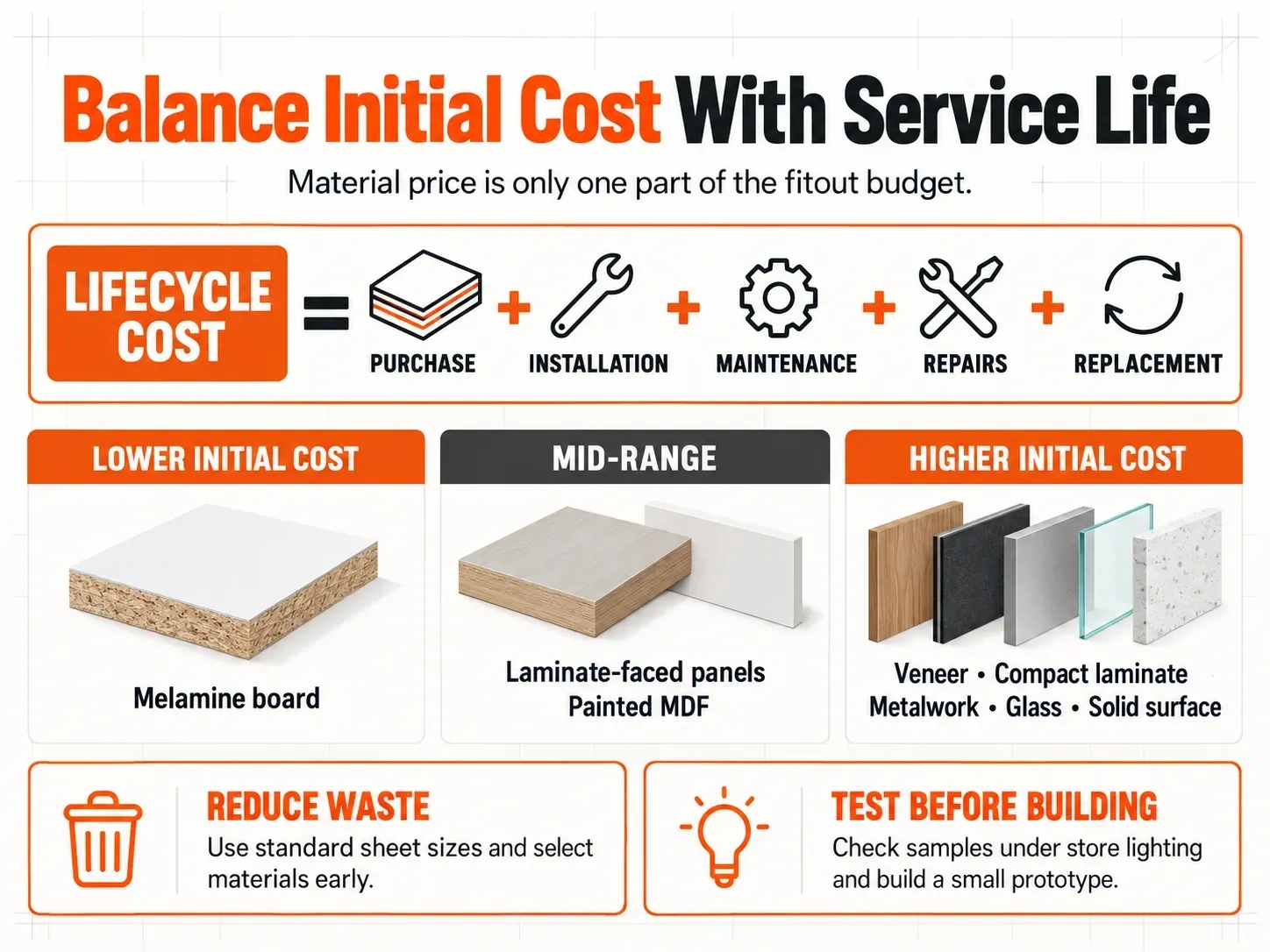
Shopfitting lifecycle cost includes purchase, installation, maintenance, repairs, and eventual replacement.
Check Safety, Compliance, and Sustainability
Material selection must align with the building use and the complete fixture design. A suitable surface can still fail when installed on the wrong substrate.
Victoria bans engineered stone benchtops, panels, and slabs. Confirm that proposed counter materials comply before approving samples or placing orders.
Some wall and ceiling fixture systems may need verified fire-hazard properties. Check the product and installed assembly with the project’s building professionals.
Retail layouts must also preserve circulation and accessible customer movement. Fixtures should not obstruct exits, services, or required clearances.
Food retailers need cleanable fixtures and suitable food-contact surfaces. Local council, landlord, centre-management, and building requirements may also apply.
For timber products, request low-emission documentation and traceable sourcing. Replaceable parts and recyclable metal frames can further reduce future waste.
Plan Your Melbourne Shopfitting Fixtures
Choose materials after defining the fixture’s use, load, environment, and maintenance needs. Then compare appearance, lead time, compliance, and lifecycle cost.
A coordinated design can place durable materials where wear is highest. Decorative materials can then create impact without unnecessary spending.
Finex Fitouts can help Melbourne businesses plan, build, and coordinate practical retail fixtures. This approach connects material selection with the wider fitout programme.
Frequently Asked Questions
Practical answers about selecting shopfitting fixture materials for Melbourne retail spaces.
What is the best material for shopfitting fixtures?
There is no single material that suits every fixture. High-pressure laminate works well for busy counters, while plywood suits strong shelving and frames. Melamine board is practical for dry storage, and metal supports slim or heavy-duty structures. The right choice depends on wear, moisture, load, cleaning, appearance, and budget.
Which shopfitting material offers the most cost-effective result?
Melamine-faced particleboard is often cost-effective for cabinet interiors and lower-impact fixtures. High-pressure laminate can provide better long-term value on frequently used surfaces. Compare installation, maintenance, repairs, and replacement costs instead of relying only on the initial material price.
What compliance checks apply to shopfitting materials in Melbourne?
Shopfitting materials may need to meet fire, accessibility, food-safety, and building requirements. Victoria also bans engineered stone benchtops, panels, and slabs. Confirm council, landlord, and centre-management conditions before ordering materials. A building surveyor or qualified fitout team should review project-specific requirements.
Compare turnkey fitout vs traditional fitout in Melbourne. Learn cost, timeline, and risk differences to choose the right option for your business.
Learn medical clinic fitout requirements in Australia, including costs, permits, layout, compliance, and Melbourne planning tips.