
How to Handle Fitout Disputes: A Practical Guide to Resolving Conflicts
Date Published

Imagine your Melbourne shop opens next month. Your contractor requests an unexpected variation payment, while unfinished work threatens your opening.
Staff need answers, rent continues, and every discussion feels harder.
To handle fitout disputes, document the problem, check the contract, notify the responsible party, and propose a specific remedy. Check payment deadlines immediately, even while you negotiate.
First, identify whether the disagreement concerns scope, defects, delays, payments, or landlord obligations. Each issue may involve different responsibilities.
Treat immediate safety concerns urgently. Contact the responsible site manager and obtain appropriate professional help.
Next, decide what outcome you need. That might mean repairs, a revised programme, or clarification of disputed charges.
Choose one contact on each side. Clear communication reduces conflicting instructions and keeps discussions focused on resolving the problem.
Check the contract and collect evidence
Useful evidence shows what both parties agreed and how the delivered work differs. Start with the signed contract and supporting documents.
Review drawings, specifications, exclusions, accepted samples, and approved variations. Check payment terms, completion dates, extension provisions, and dispute procedures.
Follow the contract’s notice requirements, including the correct recipient and delivery method.
Build a simple issue register containing:
🔸 The problem, location, and date identified.
🔸 The relevant drawing, specification, or contract requirement.
🔸 Dated photographs and supporting correspondence.
🔸 Your requested remedy and the other party’s response.
Separate defective work from unfinished work and newly requested changes. A missing cabinet differs from a cabinet excluded from scope.
Check drawing revision dates when layouts or services differ from expectations. An outdated plan can explain conflicting instructions.
For disputed workmanship, consider an independent specialist with relevant experience. Preserve evidence before repairs obscure the issue, where safe.
Keep invoices for extra storage, temporary premises, or other disruption. These records support discussions, but they do not guarantee compensation.
Raise the issue and agree on a recovery plan
Start with a factual discussion, then put the issue in writing. Explain the problem without guessing motives or assigning unsupported blame.
Include the contract reference, evidence, requested remedy, and response date. Follow contractual deadlines rather than assuming seven days always applies.
For disputed variations, request the instruction, scope, price breakdown, and claimed effect on completion.
For defects, agree on the proposed repair, responsible person, access arrangements, and completion target.
For delays, request an updated programme showing causes, dependencies, and recovery steps. Check whether notices or approvals remain outstanding.
In a Melbourne office building, lift bookings or restricted working hours may affect access. Investigate these constraints before assigning responsibility.
Returning to our hypothetical shop, compare the variation against approved drawings. Identify agreed work and record any remaining disagreement separately.
Confirm the recovery plan in writing. Include responsibilities, dates, payment arrangements, and how everyone will check completion.
Before signing settlement terms that release claims, obtain legal advice about what rights you would surrender.
Can you withhold payment during a fitout dispute?
Withholding payment can carry consequences. Check your contract and applicable payment rules before deciding how to respond.
An invoice discussion differs from responding to a statutory payment claim. A complaint email may not satisfy formal requirements.
Under applicable Victorian payment claim rules, payment schedules generally have a 10-business-day deadline. An earlier contractual deadline can apply.
A payment schedule identifies the amount you propose to pay and explains any reduction. Missing the deadline can expose you to liability for the claimed amount.
Seek prompt advice if a claim invokes security-of-payment legislation. Do not assume negotiations extend the deadline.
Victoria changed these rules in April 2026, and transitional provisions can affect earlier claims.
Assess each disputed amount and your obligations. Avoid using blanket non-payment as a negotiating tactic.
Also check your rights before terminating the contract, directing work to stop, or appointing a replacement contractor. Those decisions can create additional disputes.
Where can Melbourne businesses get help?
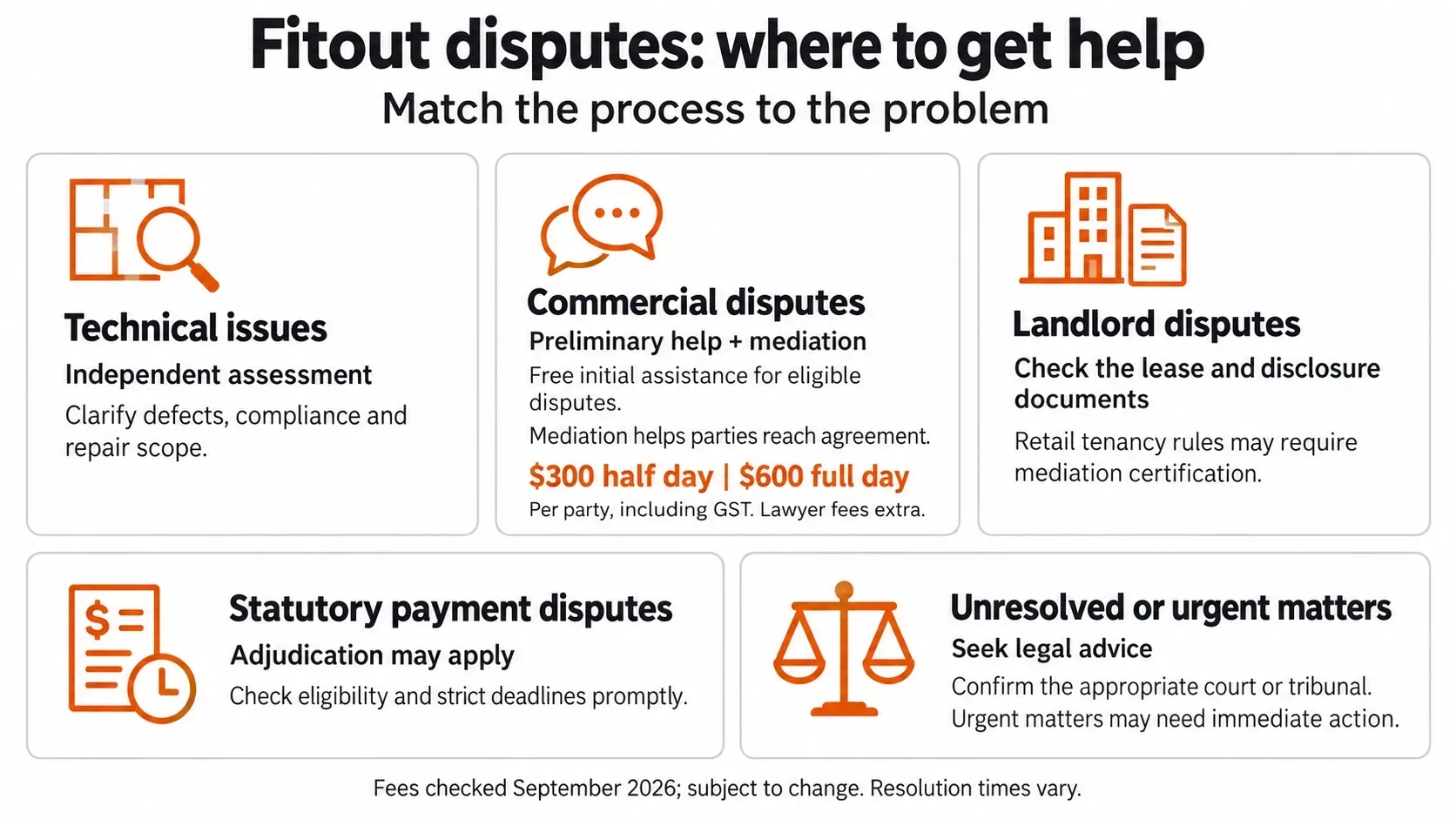
The right assistance depends on the disagreement, the parties, and your contract. Match the process to the problem.
For technical disagreements, an independent assessment can clarify defects, compliance questions, and repair scope. Agree on the assessor’s instructions where possible.
For eligible commercial disputes, commercial dispute assistance includes free preliminary help and subsidised mediation.
As checked in September 2026, published mediation fees are $300 per party for half a day. A full day costs $600 per party. Both include GST, and fees can change.
Your own lawyer’s fees are additional.
A mediator helps parties negotiate an agreement. They do not impose a judgment.
Landlord disagreements may involve consent, lease obligations, fitout contributions, or reinstatement requirements. Compare the lease and disclosure documents with your construction agreement.
Specific retail tenancy dispute procedures can require mediation certification before tribunal proceedings. Not every commercial lease falls under retail leasing legislation.
Eligible statutory payment disputes may follow adjudication, a separate process with strict deadlines.
If negotiations fail, obtain advice about the appropriate court or tribunal. Urgent matters may require immediate legal action.
No single resolution timeframe suits every dispute. Complexity, evidence, cooperation, and the chosen process affect progress.
Reduce disputes on your next Melbourne fitout
Clear scope, recorded approvals, and defined responsibilities make problems easier to address. Confirm landlord requirements, access arrangements, and handover expectations early.
Check building permit requirements with your building surveyor. Record who will organise approvals and required inspections.
Document each variation’s scope, price, and time impact before proceeding where practical. Review progress regularly and record decisions.
For your next Melbourne project, discuss your scope, approvals, and delivery expectations with Finex Fitouts. Its design, construction, and project management services can help you plan responsibilities from the outset.
Frequently Asked Questions
Practical answers to common commercial fitout dispute questions in Melbourne.
What evidence should I collect for a commercial fitout dispute?
Collect records showing what you agreed and how the work differs. Include the signed contract, approved drawings, variations, invoices, dated photographs, and correspondence. Create a timeline of problems and responses. For disputed defects, consider an independent technical assessment. Keep records of additional costs, although these do not automatically establish a right to compensation.
How do I dispute an unexpected fitout variation charge?
Compare the charge with your original scope and the contract’s variation procedure. Ask for the instruction, approval record, cost breakdown, and any claimed effect on completion. Explain your disagreement in writing and request a response. Do not assume missing written approval automatically removes payment obligations. Seek prompt advice if you receive a statutory payment claim.
Can mediation help resolve a Melbourne fitout dispute?
Mediation can help parties negotiate repairs, payment arrangements, or a revised completion plan. An independent mediator guides discussions but does not impose a decision. Eligible Victorian commercial disputes can access subsidised mediation. The appropriate process depends on whether your disagreement involves a contractor, landlord, or statutory payment claim. Check urgent deadlines while arranging help.

Learn what a turnkey fitout includes, Melbourne costs, timelines, risks, and how to avoid delays and budget blowouts.

Compare fitout vs refurbishment, including scope, costs, timelines and approvals, for your Melbourne commercial space.