
What Happens If Compliance Issues Are Found After Leasing?
Date Published

A compliance issue can stop affected work, delay occupation, and create unexpected costs. Serious safety concerns may also prevent staff or customers from entering an area.
Signing a lease does not confirm that the premises support your intended business. Landlord consent also does not replace planning, building, or occupancy approval.
Common issues include unapproved alterations, an unsuitable approved use, and missing fire safety measures. Other problems involve accessibility, electrical systems, plumbing, ventilation, or hazardous materials.
Your proposed use or renovation may need separate planning or building permits. A building surveyor or council may require documents, design changes, inspections, or rectification.
The problem does not always make the entire premises unusable. A qualified adviser should define the affected area and any immediate restrictions.
Fast Facts
- First response: Stop affected work, control safety risks, document the issue, and notify the landlord in writing.
- Approvals: A signed lease and landlord consent do not replace planning, building, or occupancy approval.
- Responsibility: Who pays depends on the lease, defect, intended use, and cause of the required work.
- Safety: Suspected asbestos, fire risks, and unsafe areas need specialist assessment before work continues.
- Close-out: Do not occupy until all required inspections, permits, and completion records are in place.
What Should You Do First?
Stop work that could worsen the defect, hide evidence, or create a safety risk. Do not remove walls, ceilings, or services until specialists assess the issue.
If asbestos may be present, avoid drilling, cutting, or demolition. Workplace rules require careful identification and management before refurbishment affects suspected material.
Follow these immediate steps:
🔸 Photograph the issue and record when it was discovered.
🔸 Secure unsafe areas and brief employees and contractors.
🔸 Notify the landlord or property manager in writing.
🔸 Gather the lease, disclosure statement, plans, permits, and condition report.
🔸 Ask a qualified professional to define the defect and required response.
Use a registered building surveyor for building approval questions. Other issues may require an architect, engineer, access consultant, fire specialist, hygienist, or leasing lawyer.
Ask the surveyor whether a building permit is required. Get the answer in writing before restarting affected work.
Who Pays for the Compliance Work?
No single rule makes every compliance cost the landlord’s or tenant’s responsibility. The answer depends on the lease, defect, timing, and reason for the work.
A landlord may carry responsibility for a pre-existing structural defect or landlord-owned service. A tenant may carry responsibility for its fitout, equipment, business use, or damage.
Responsibility becomes less clear when a tenant’s proposed use triggers an upgrade. For example, a new layout may affect exits, toilets, access, ventilation, or fire systems.
Review these documents before agreeing to pay:
🔸 The lease and any agreement for lease
🔸 The landlord’s disclosure statement
🔸 The entry condition report and photographs
🔸 The permitted-use and fitout clauses
🔸 Repair, compliance, outgoings, and make-good clauses
🔸 Landlord approvals and pre-lease representations
Victorian retail leases receive specific statutory protections. These can override conflicting lease terms in some circumstances.
For qualifying retail premises, landlords generally have defined repair and maintenance obligations. However, exceptions may apply to tenant misuse or removable tenant items.
Other commercial leases depend more heavily on their negotiated wording. Seek legal advice before withholding rent, terminating the lease, or commissioning disputed work.
How Are Compliance Issues Rectified?
First, classify the issue correctly. A building defect, planning restriction, workplace hazard, and lease breach may require different processes.
The project team should then prepare a written rectification plan. The plan should explain the cause, affected area, required work, approvals, cost, and programme.
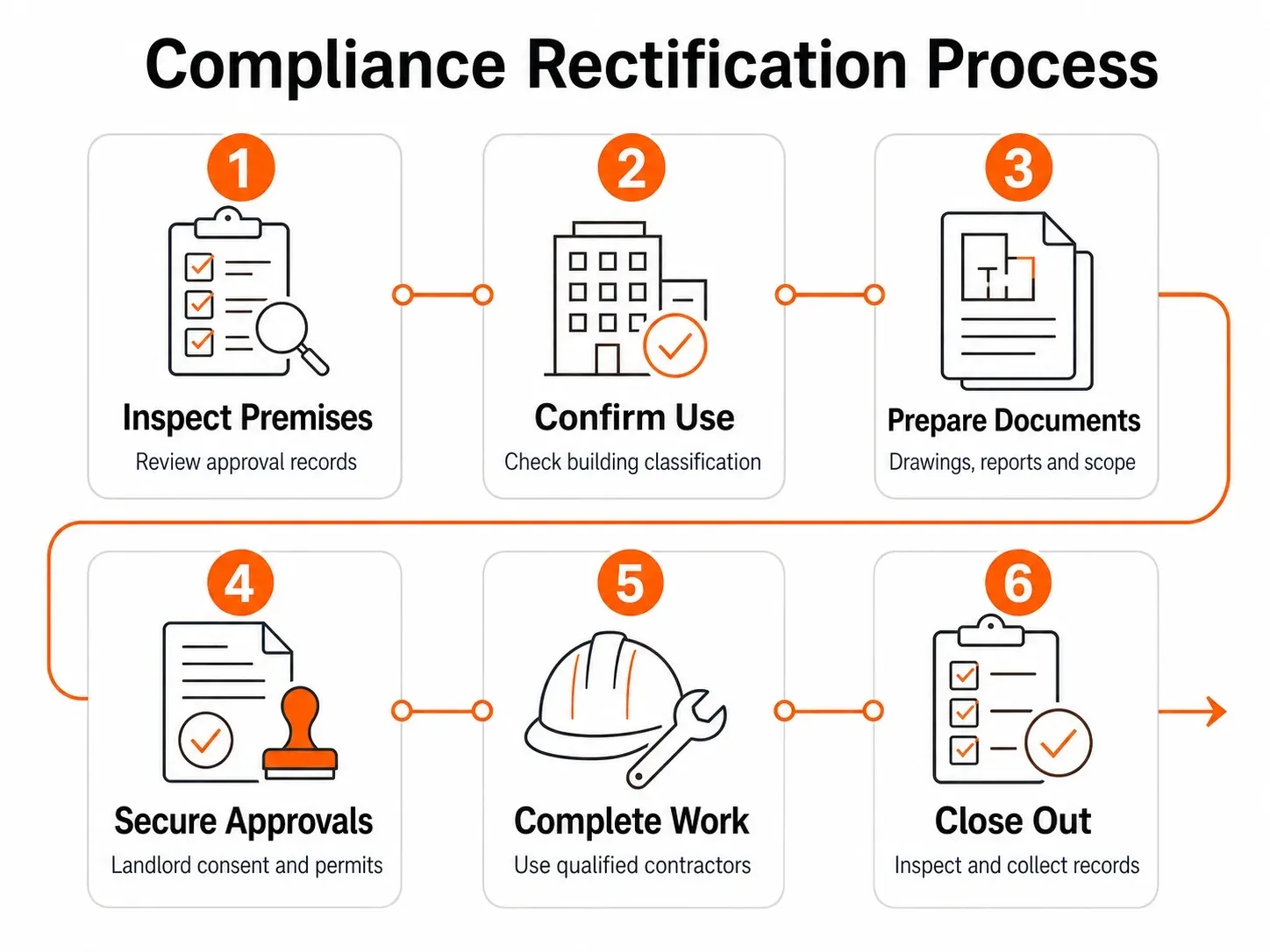
A practical six-step process for identifying, approving, rectifying and closing out compliance issues in leased commercial premises.
Suspected asbestos needs a separate safety response. Relevant material must be identified before refurbishment starts, using the applicable workplace asbestos duties.
Do not assume that retrospective paperwork will solve unlawful work. Inspectors may require opening, testing, alteration, or replacement before accepting compliance.
Non-compliant work can attract a formal direction, notice, or order. The required response may include reports, rectification, further inspection, or stopping work.
Your permit should identify the approval needed before occupation. Do not open the premises until every required approval and safety condition has been satisfied.
How Can You Limit Delays and Business Disruption?
Create one action register for the landlord, consultants, contractor, and tenant. Give every item an owner, deadline, approval requirement, and completion record.
Separate opening-critical work from improvements that can occur later. A surveyor must confirm whether this staged approach remains safe and lawful.
Track the full financial effect, not only construction costs. The issue may affect rent, consultant fees, storage, contractor variations, staffing, finance, and stock deliveries.
Notify relevant insurers promptly. Late notice or unauthorised work can affect available cover.
Keep all notices, reports, invoices, photographs, and meeting records. Clear evidence helps the parties negotiate responsibility and assess any compensation claim.
If negotiations fail, consider mediation or legal advice. Do not let an unresolved payment dispute delay urgent safety controls.
For future leases, make due diligence a formal condition. Check the approved use, permit history, building services, accessibility, safety measures, and hazardous-material records.
Plan the Rectification Before Restarting Your Fitout
A compliance discovery does not always end a project. Early investigation can separate a manageable correction from a larger approval problem.
Finex Fitouts can coordinate inspections, design changes, approvals, construction, and project scheduling for Melbourne commercial spaces.
Before restarting work, confirm the rectification scope, responsibilities, approvals, budget, and revised programme. This protects your opening date and reduces further disruption.
Frequently Asked Questions
Practical answers for Melbourne businesses dealing with compliance issues after leasing commercial premises.
What should I do if a compliance issue is found after signing a commercial lease?
Stop any work that could worsen the issue or create a safety risk. Document the problem and notify the landlord in writing. Then ask a qualified building surveyor or relevant consultant to assess the premises. Review the lease, disclosure statement, approved plans, permits, and condition report before authorising rectification.
Who pays to fix compliance issues in leased commercial premises?
Responsibility depends on the lease, the cause of the issue, and whether it existed before the tenancy. Landlords may be responsible for certain structural defects and landlord-owned services. Tenants may be responsible for their fitout, equipment, damage, or business-specific upgrades. Victorian retail leasing laws may also override some lease terms, so obtain legal advice for disputed or high-value work.
Can a business continue its fitout while a compliance issue is being resolved?
Unaffected work may continue if the relevant building surveyor and project consultants confirm it is safe and lawful. Work should stop near unsafe structures, suspected asbestos, unapproved construction, or affected fire systems. Before restarting, confirm the approved scope, required permits, inspection stages, responsibilities, and completion evidence in writing.

Compare design and construct vs turnkey fitout for Melbourne commercial spaces. Learn costs, risks, timelines, and when each model works.

Learn which approvals commercial fitouts may need in Melbourne, from planning and building permits to landlord and trade sign-offs.