
Why RCD Keeps Tripping in Commercial Buildings (Fix Guide)
Author
Shawn Vandersay
Date Published

An RCD trips when it detects an imbalance between outgoing and returning electrical current. This can indicate electricity escaping through an unintended path.
Common causes include faulty appliances, moisture, damaged wiring and accumulated leakage from electronic equipment. Wiring errors or a defective protective device can also contribute.
Consider an illustrative Melbourne office where reception computers lose power before opening. Staff suspect the newest printer, but several devices may contribute leakage. The last appliance switched on does not necessarily contain the fault.
Understanding the difference between safety switches and circuit breakers helps avoid incorrect assumptions:
🔸 An RCD detects residual current, commonly associated with earth leakage.
🔸 A circuit breaker protects against overloads and short circuits.
🔸 An RCBO combines residual-current and overcurrent protection.
Therefore, excessive load alone does not explain every RCD trip. First, ask an electrician to identify the device and fault.
Fast Facts (TL;DR)
- Common causes: Faulty equipment, moisture, damaged wiring and accumulated leakage can trigger repeated RCD trips.
- Know the device: RCDs detect residual current. Circuit breakers protect against overloads. RCBOs combine both functions.
- Respond safely: Stop using affected equipment, report the incident and arrange professional investigation. Never bypass protection or repeatedly reset it.
- Plan the repair: Confirm access, shutdown needs, testing and applicable certification. Review electrical requirements before adding equipment.
What commonly causes commercial RCD trips?
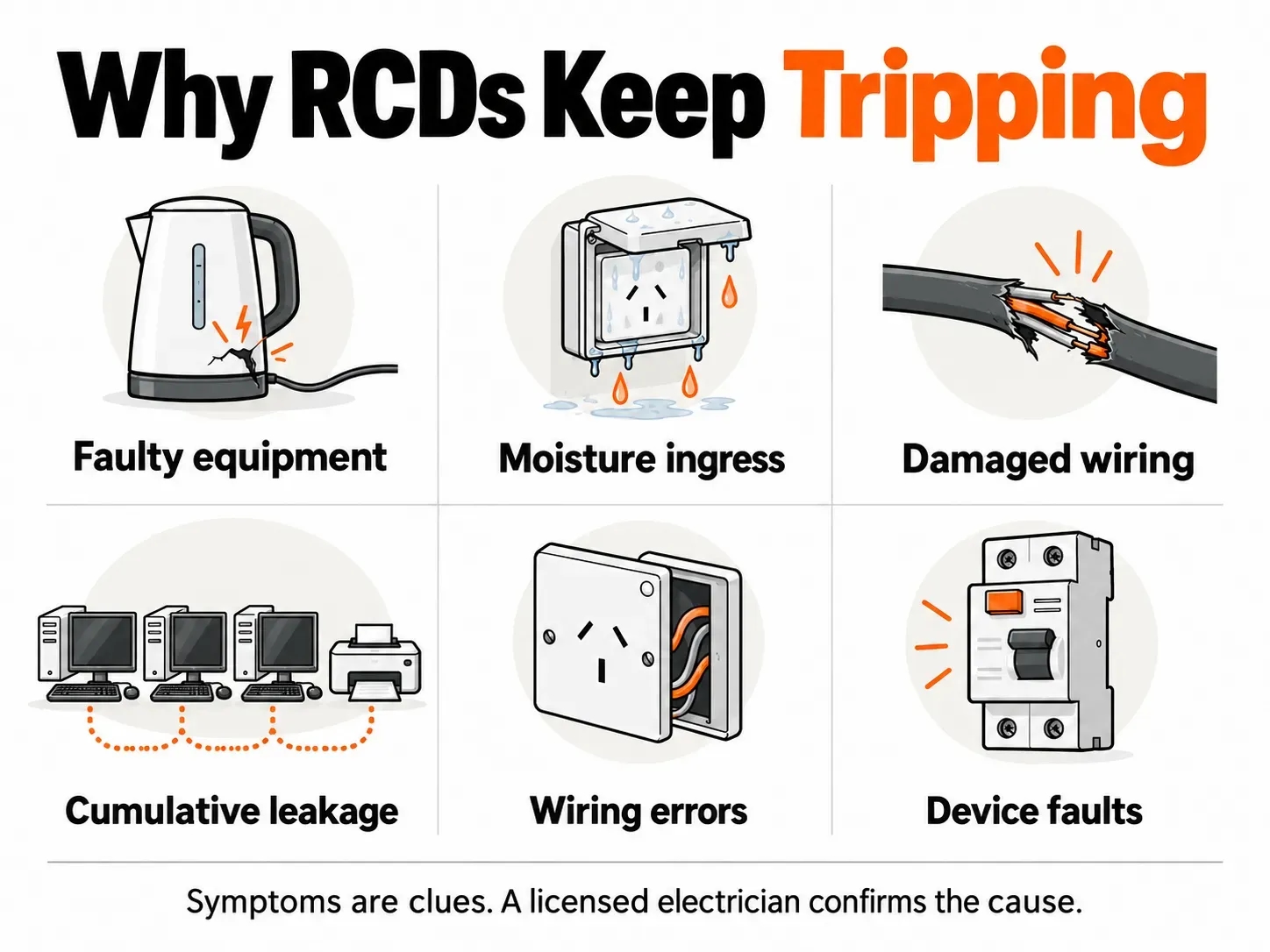
Common causes of repeated RCD trips. A licensed electrician must confirm the fault.
Trip patterns help narrow the investigation, but they cannot confirm a diagnosis. Record what happened before each interruption.
Faulty equipment: Appliances, heating elements and damaged flexible leads can develop insulation faults. A problem may appear only when equipment heats up or enters a particular operating cycle.
Moisture: Water entering equipment, outlets or wiring can create leakage paths. Note whether trips follow cleaning, rain or plumbing leaks. Never touch wet electrical equipment.
Damaged wiring: Ageing insulation, crushed cables or damage during building work can create faults. Tell the electrician about recent drilling, partition changes or ceiling works.
Cumulative leakage: Computers and other electronic equipment can produce small leakage currents during normal operation. These currents can accumulate under shared protection. Electronic equipment and switching disturbances can therefore contribute to unwanted tripping.
Wiring errors: Incorrect neutral connections and neutral-to-earth faults can cause confusing trip patterns. Technical guidance identifies moisture, accumulated leakage and neutral wiring faults as potential causes.
Device faults: The RCD itself may require replacement, but repeated trips alone do not prove this. Testing should establish the cause before replacement.
Timing provides useful clues. Trips during cleaning suggest a different investigation from trips after new workstations arrive. However, either pattern still needs professional assessment.
What should staff do when the power trips?
Stop using affected equipment and notify the responsible manager. Follow your workplace electrical safety and emergency procedures.
Keep people clear of wet equipment, exposed wiring, sparks or burning smells. For fire or immediate danger, follow evacuation procedures and call 000.
Where conditions are safe, staff can record information without opening electrical enclosures:
🔸 Record the trip time and affected rooms or equipment.
🔸 Note recent cleaning, leaks, deliveries or electrical alterations.
🔸 Identify equipment operating immediately before the trip.
🔸 Report visible damage without touching hazardous equipment.
🔸 Arrange a licensed electrician to investigate repeated trips.
Only disconnect accessible plug-in equipment when safe and permitted by workplace procedures. Do not handle damaged plugs or wet leads.
Do not repeatedly reset the device, bypass protection or move suspected faulty equipment to another circuit. Avoid improvised extension-lead arrangements.
Keep suspect equipment out of service until an appropriate person clears it. These actions support safe electrical equipment management at work.
For refrigeration, medical equipment or essential systems, activate the relevant continuity procedure immediately. Do not let operational pressure override safety.
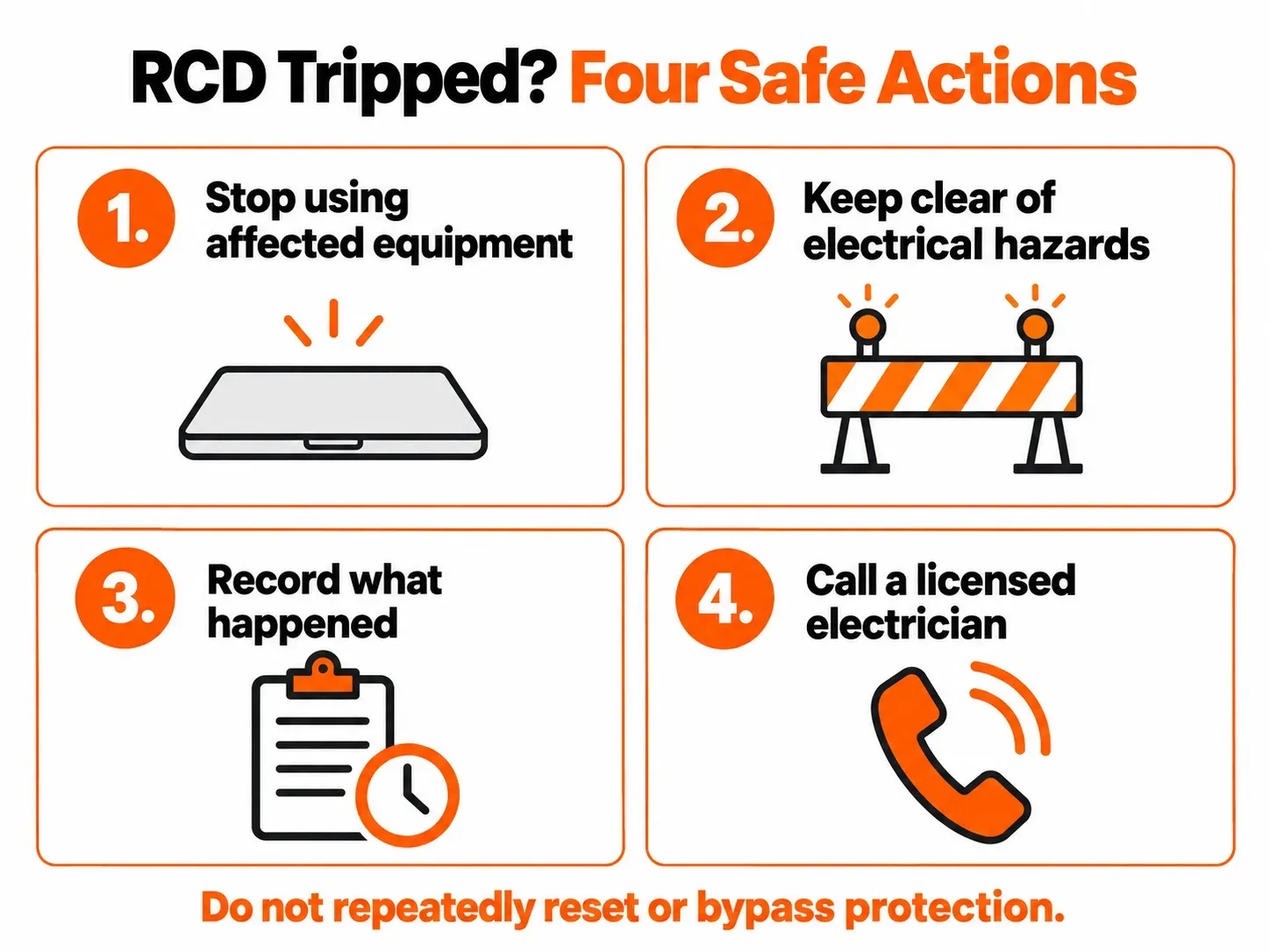
Record the incident and arrange professional help instead of repeatedly resetting the RCD.
How does an electrician find and fix the fault?
An electrician first identifies the protective device, affected circuits and operating conditions. Your incident record helps focus the investigation.
They may measure leakage, test insulation and assess RCD operation using suitable instruments. They also check equipment and wiring connections.
These tests require professional judgement. Sensitive equipment may need disconnection or special precautions before testing.
The repair depends on the findings. Options include repairing an appliance, replacing damaged wiring, correcting connections or replacing a defective RCD.
Moisture-related faults also require attention to the water source. Restoring power without addressing the leak can leave a recurring problem.
If shared protection causes widespread disruption, the electrician may recommend changes to circuit arrangements. Any changes must retain required protection.
Tripping with appliances unplugged does not automatically mean the RCD has failed. Fixed equipment, wiring faults or other connected circuits may remain involved.
After repairs, request the findings and relevant test records. Victorian electrical installation work requires a Certificate of Electrical Safety. Some work also requires independent inspection.
How can businesses control costs and prevent repeat outages?
Ask for a clear investigation scope before approving permanent repairs. A diagnosis provides a stronger pricing basis than symptoms alone.
Request separate allowances for attendance, fault-finding, parts, labour, testing and applicable certification. Confirm GST, after-hours charges and approval limits.
A simple equipment fault differs from concealed wiring damage. Intermittent faults may require monitoring or another visit, so avoid assuming a fixed completion time.
Confirm access with the landlord or building manager. Shopping centres may require approved shutdown windows, inductions and coordination with neighbouring tenants.
Our guide to shopping centre fitout coordination explains these access and shutdown considerations.
Before adding workstations or appliances, review circuit capacity and leakage with the electrician. Keep circuit labels and equipment records current.
Agree a testing schedule suited to the workplace and equipment. Construction sites require separate consideration from ordinary operating premises.
Plan electrical upgrades with your fitout
Electrical requirements should form part of your fitout plan from the beginning. Early coordination helps align equipment, layout and shutdown arrangements.
Finex Fitouts can help coordinate these requirements within your Melbourne commercial fitout or refurbishment. Discuss your planned equipment and operational needs before finalising the scope.
For an active electrical fault, contact a licensed electrical contractor promptly.
Commercial RCD Tripping FAQs
Practical answers for Melbourne business owners and facilities managers.
Why does the RCD trip when everything is unplugged?
Unplugging portable appliances does not disconnect fixed equipment or remove faults within the wiring. Shared protection may also cover other circuits. Neutral-to-earth faults or a defective RCD can contribute. Keep the affected circuit out of use and arrange professional testing. The symptom alone cannot identify which component needs repair.
Can too many computers cause an RCD to trip?
Yes. Small leakage currents from electronic equipment can accumulate under shared RCD protection. This differs from an overload, although a combined RCBO can respond to either condition. An electrician can measure leakage and assess circuit arrangements. Never remove protection or increase its trip threshold simply to stop interruptions.
How often should commercial RCDs be tested in Victoria?
Testing intervals depend on the device, workplace environment, use and applicable requirements. Push-button checks and instrument tests serve different purposes. Ask a competent person to establish the schedule using relevant guidance and manufacturer instructions. Construction sites require separate consideration. Investigate repeated trips immediately rather than waiting for the next scheduled test.
Learn turnkey fitout costs in Australia 2026. Melbourne pricing, timelines, hidden costs, and how to avoid budget blowouts.

Retail fitout cost Australia guide for 2026. Learn real prices, timelines, risks, and how Melbourne businesses can avoid costly mistakes.